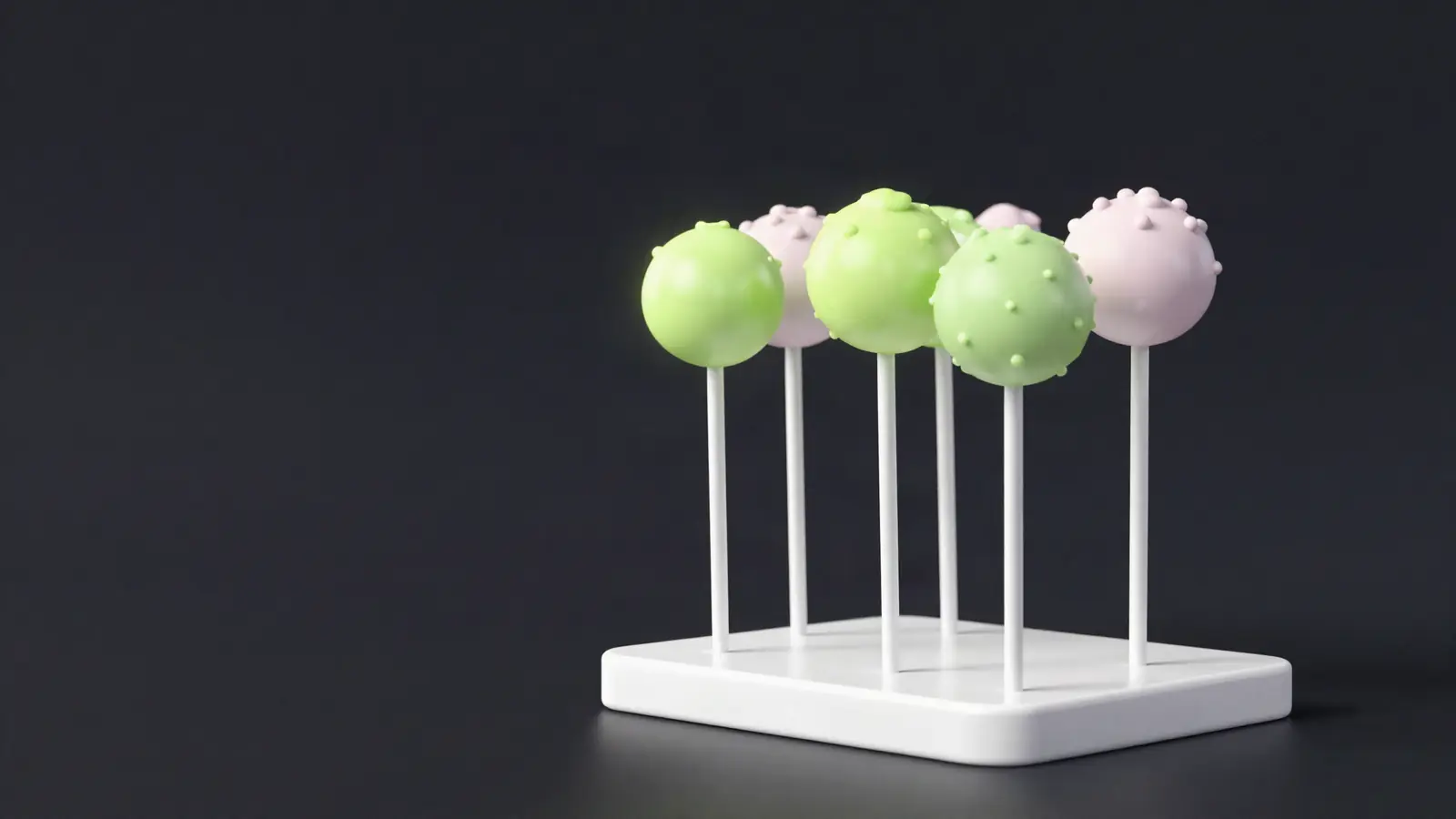
Cake pops look like a cheap treat to make. One box of cake mix, a bag of candy melts and a pack of sticks can turn out two dozen of them. But every pop is rolled, chilled, stuck, dipped, decorated and bagged by hand, and that time is where most home bakers lose money. This guide shows what a cake pop really costs, walks through a full per-dozen example, and sets out prices for basic, decorated and custom pops.
How much should you charge for cake pops?
Charge for cake pops by adding up the batch's ingredients, sticks and packaging, your hands-on time at an hourly rate and a small overhead allowance, then adding a profit margin and dividing by the number of pops. In the worked example below, 24 basic dipped cake pops cost about $3.42 each to make and sell for about $4.88 each, or $58.61 a dozen. Decorated and character pops cost more because they take more time, not more cake.
Those figures come from the example assumptions stated below, not from a survey of market prices. Your own number depends on your costs, your speed and what customers near you pay.
What goes into the cost of a cake pop?
| Cost | What to include |
|---|---|
| Cake and binder | Cake mix or scratch cake, eggs, oil, plus the frosting that holds the crumbs together |
| Coating | Candy melts or chocolate, plus any thinning agent |
| Decorations | Sprinkles, drizzle colors, candy eyes, fondant pieces |
| Sticks | One per pop |
| Packaging | Treat bags, twist ties or ribbon, boxes or display stands |
| Your time | Baking, crumbling, rolling, dipping, decorating, bagging and cleanup |
| Overhead | A percentage for electricity, equipment wear and supplies you don't track per order |
Wilton's basic cake pop recipe is a useful reference for quantities. It uses one box of cake mix, a 3.4 oz box of instant pudding mix, half a cup of buttercream and a 12 oz bag of Candy Melts. Wilton says the batch makes about 48 small pops (1 tablespoon each), about 24 medium pops (2 tablespoons) or about 16 large pops (3 tablespoons).
That yield range matters for pricing. The same ingredients cover 16 or 48 pops depending on size, so decide your standard size before you quote anything.
Why are cake pops so labor-heavy?
The ingredients are cheap. The handling isn't. Each pop is touched several times:
- Bake and cool the cake, then crumble it and mix in the frosting.
- Roll every ball by hand to the same size.
- Chill. Wilton's recipe chills the formed balls for about 2 hours before the sticks go in.
- Insert sticks dipped in melted candy, then chill again for about 10 minutes.
- Dip each pop one at a time, tap off the excess and add sprinkles before the coating sets.
- Chill again, then bag, tie and box every pop.
The chilling is hands-off, so it isn't counted as labor. It does mean cake pops are hard to turn around the same day, which is why rush orders need their own price (more on that below).
What does a worked example look like?
A batch of 24 medium basic cake pops: one coating color, sprinkles, individually bagged.
For this example, assume the ingredient and packaging prices below. They are illustrative, not quotes from a specific store, so swap in what you actually pay. We've counted two 12 oz bags of candy melts even though Wilton's recipe lists one, so there's enough depth in the cup to dip each pop in one motion.
For the hourly rate, assume $20. For context, the Bureau of Labor Statistics reports median pay for bakers of $17.86 an hour as of May 2025.
| Cost | Batch | Per pop |
|---|---|---|
| Cake mix ($2.00), pudding mix ($1.50), eggs and oil ($1.50), frosting ($1.00) | $6.00 | |
| Candy melts: 2 bags × $5.00 | $10.00 | |
| Sprinkles | $1.00 | |
| Ingredients subtotal | $17.00 | $0.71 |
| Sticks: 24 × $0.05 | $1.20 | |
| Treat bags and ties: 24 × $0.10 | $2.40 | |
| Boxes: 2 × $2.00 | $4.00 | |
| Packaging subtotal | $7.60 | $0.32 |
| Your time: 2.5 hours × $20/hour | $50.00 | $2.08 |
| Overhead: 10% | $7.46 | $0.31 |
| Total cost | $82.06 | $3.42 |
At a 30% profit margin, the batch price is $82.06 ÷ 0.7 = $117.23. Divided by 24, that's $4.88 per cake pop, or $58.61 a dozen. Rounded to a clean menu price, that's $5.00 each and $60 a dozen.
Look at where the money goes. Ingredients are about 71 cents a pop. Your time is $2.08, nearly three times as much. Your hourly wage plus the profit works out to about $34 for every hands-on hour.
A 30% margin is a starting point, not a rule. Your hourly rate already pays you, so the margin is what the business keeps for equipment, slow weeks and growth.
How should you price basic, decorated and custom cake pops?
Keep the batch at 24 pops and change only the decorating time and extra supplies. For this example, assume decorated pops (a second color, a drizzle, placed sprinkles) take 1.5 extra hours and $3 of extra supplies. Custom or character pops (faces, ears, candy eyes, fondant pieces) take 3.5 extra hours and $8 of extra supplies.
| Tier | Hands-on time | Ingredients | Cost per pop | Price per pop | Price per dozen |
|---|---|---|---|---|---|
| Basic dipped | 2.5 hours | $17.00 | $3.42 | $4.88 | $58.61 |
| Decorated | 4 hours | $20.00 | $4.93 | $7.05 | $84.54 |
| Custom or character | 6 hours | $25.00 | $6.99 | $9.99 | $119.90 |
All three use the same packaging ($7.60), the same $20 rate, 10% overhead and a 30% margin.
The ingredients barely change between tiers. The price roughly doubles because the hours more than double. It's the same pattern as decorated cookies, where royal icing time drives almost the whole price.
Time yourself on a real batch at each tier once, then reuse those hours when you quote. If a customer asks for a new character design, add the time to work it out as a one-off design fee rather than folding it into every future order.
Should cake pops have a minimum order?
A minimum usually makes sense, and a dozen is a natural one. Baking the cake, mixing, the 2-hour chill and cleanup take about the same effort for 6 pops as for 24. Spread over half a dozen, those fixed steps push your cost per pop up sharply.
If you do sell smaller orders, price them per pop above your dozen rate instead of simply halving the dozen price. The same logic appears in our cupcake pricing guide, where half-dozens carry a slightly higher per-piece price.
How much should you charge for rush orders?
Cake pops need chilling between steps, so a rush order usually means moving other work or staying up late. Set a rush policy in advance so you aren't negotiating under pressure. Three simple structures:
- A flat rush fee added to any order needed inside your normal lead time.
- A percentage surcharge on the order total, which scales with bigger orders.
- An extra hour or two of labor in your cost, priced through the same margin.
Whichever you choose, it's your policy, not an industry standard. Make sure it covers the real cost of the disruption to your week.
How do you sanity-check your cake pop price?
Once you have a cost-based price, compare it with what bakeries and home bakers near you charge for similar pops. If yours is much higher, look at the biggest cost lines before cutting your wage. Smaller or larger pop sizes, fewer colors, batching one design, or cheaper packaging all change the numbers. If yours is much lower, you're probably leaving your time out.
The same checks apply across your menu. Our guide to home bakery pricing mistakes covers the most common ways bakers undercharge, and pricing custom cakes per serving shows how to quote bigger celebration orders.
To run your own numbers, open the baked goods pricing calculator. Choose "Something else", enter the number of pops in your batch, and add your ingredients, packaging, hours, overhead and margin. It shows your cost and price per item (each pop), the price for the whole batch and what you earn per hour. It doesn't show a dozen price for this option, so multiply the per-pop price by 12.
Do you need a license to sell cake pops from home?
In the US, selling food made in your home kitchen falls under state cottage food laws. The National Agricultural Law Center's state-by-state compilation notes that there is "much variation in the approaches taken by the states". Rules on permits, labels, where you can sell and sales limits differ from state to state. Check your own state's rules before you take orders. If your filling or coating needs refrigeration, confirm your state's program allows it.