Most home bakers price each new item from scratch: a guess for the banana bread, a different guess for the cinnamon rolls, and a number copied from someone else for the pie. That's how one product ends up paying you well while another quietly loses money. You don't need a separate method for every bake. You need one formula, used the same way every time.
How much should you charge for baked goods?
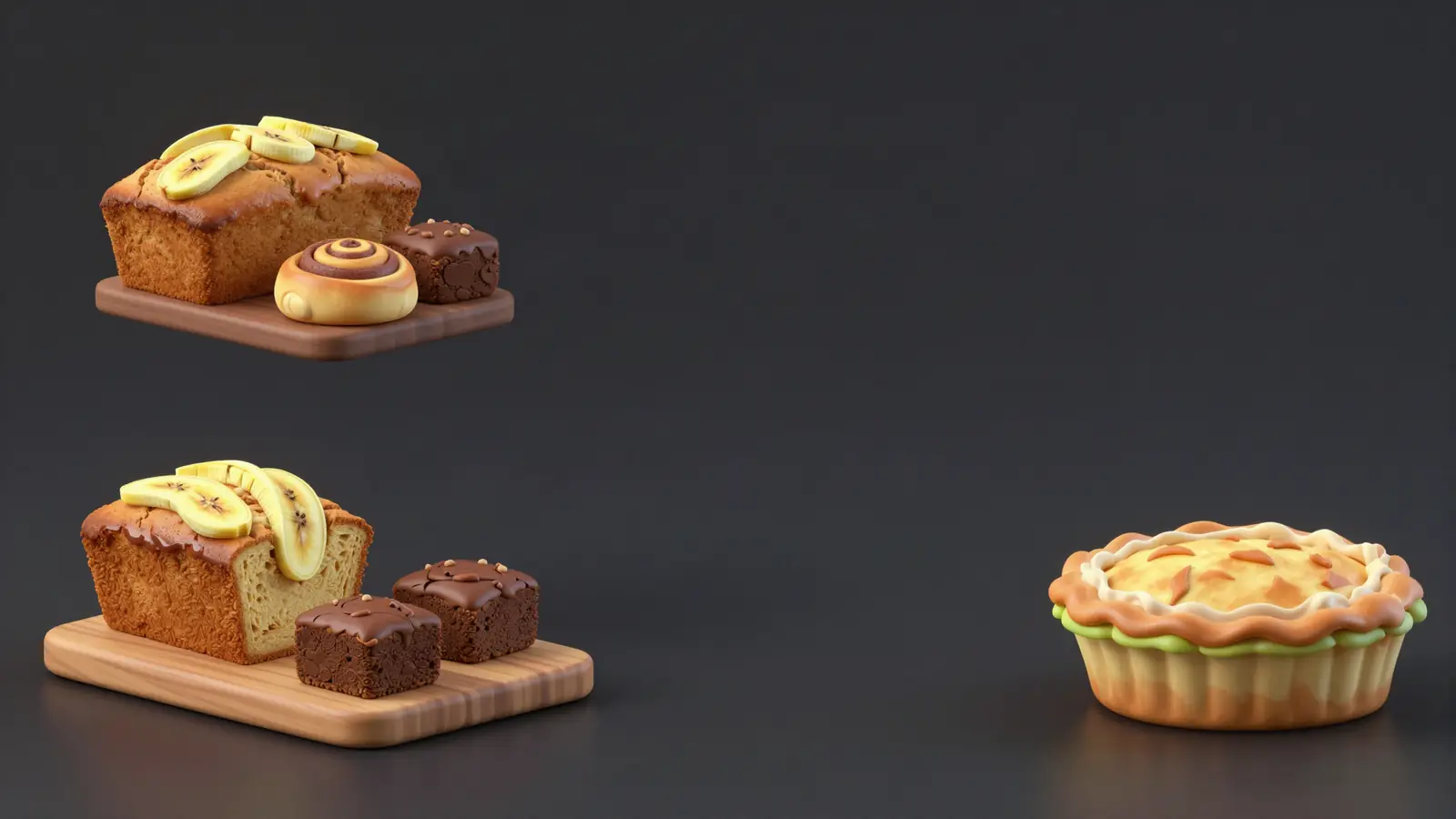
Charge for baked goods by adding the batch's ingredients, packaging, your hands-on time at an hourly rate and a small overhead allowance, then adding a profit margin and dividing by the number of pieces. Using the same assumptions for every item below, that works out to about $13.50 a loaf of banana bread, $5.50 a cinnamon roll ($66 a dozen), $2.25 a brownie and $41 a pie.
Those prices come from example costs, not market data. The method is what carries over.
What is the formula for pricing baked goods?
Five steps, in this order:
- Ingredients for the whole batch, including fillings, glazes and toppings.
- Packaging: bags, boxes, foil pans, labels, twist ties.
- Your time: hands-on hours × the hourly rate you want to earn. Count mixing, shaping, baking, icing, wrapping and cleanup. Don't count rising or cooling time when you're doing something else.
- Overhead: a percentage of the three costs above for electricity, pan and mixer wear, parchment and cleaning supplies. 10% is a simple starting point.
- Profit: divide the total cost by (1 − your margin). A 30% margin means dividing by 0.7.
Then divide the batch price by how many pieces it makes. Your hourly rate pays you for your work; profit is what the business earns on top.
What should common baked goods cost?
For every item below, assume $20 an hour for your time, 10% overhead and a 30% profit margin. Ingredient, packaging and time figures are illustrative assumptions for this example, not typical costs. Replace them with your own receipts and a timed bake day.
| Item (batch) | Ingredients | Packaging | Hands-on time | Total cost | Batch price | Price each |
|---|---|---|---|---|---|---|
| Banana bread (4 loaves) | $11.00 | $3.00 | 1 hour | $37.40 | $53.43 | $13.36 → $13.50 a loaf |
| Cinnamon rolls (12 rolls) | $9.00 | $3.00 | 1.5 hours | $46.20 | $66.00 | $5.50 a roll |
| Brownies (9 × 13 pan, 24 squares) | $10.00 | $4.00 | 1 hour | $37.40 | $53.43 | $2.23 → $2.25 a square |
| Fruit pie (4 pies) | $36.00 | $8.00 | 3 hours | $114.40 | $163.43 | $40.86 → $41.00 a pie |
The "price each" figures are rounded up to the next quarter, which is what the baked goods pricing calculator does for a clean menu price.
For a reference point on staples, the Bureau of Labor Statistics publishes monthly US average prices for items like eggs and bananas, but your own receipts are the numbers to use.
How much should you charge for cinnamon rolls?
Here's the cinnamon roll row worked through line by line, with every assumption stated.
Assumptions: one pan of 12 rolls; $9.00 of ingredients (enriched dough, butter, cinnamon sugar filling, cream cheese icing); $3.00 for a foil pan with a lid and a label; 1.5 hours of hands-on work (mixing, rolling, cutting, baking, icing, packing, cleanup), not counting the two rises; $20 an hour; 10% overhead; 30% margin.
| Step | Calculation | Amount |
|---|---|---|
| Ingredients | $9.00 | |
| Packaging | $3.00 | |
| Your time | 1.5 hours × $20 | $30.00 |
| Overhead | 10% × $42.00 | $4.20 |
| Total cost | $46.20 | |
| Batch price | $46.20 ÷ 0.7 | $66.00 |
| Per roll | $66.00 ÷ 12 | $5.50 |
So a dozen sells for $66, and a half-dozen for $33 if you sell them that way. Your wage plus the batch's $19.80 of profit works out to about $33 for each hands-on hour.
Notice where the money goes. Ingredients are under a fifth of the total cost; your time is nearly two-thirds of it. Time is also the largest cost in every other row of the table, which is why a baker who prices at "ingredients times two" ends up working for free.
How much should you charge for banana bread?
Banana bread shows batch size doing the work. Four loaves take about the same hands-on time as two: one bowl, one oven load, one cleanup. In the table, $20 of labor is spread across four loaves, so each carries $5 of your time instead of $10.
Walnuts, chocolate chips or a streusel top add ingredient cost, so price those loaves as separate products. The same logic applies to sourdough loaves with add-ins.
Why does pie cost so much to price properly?
From-scratch crust and peeled fruit take real hands-on time. Bake a single pie in 1.5 hours with $9 of ingredients and a $2 tin, and the same formula gives a total cost of $45.10 and a price of about $64.50 for one pie.
Batching four pies in 3 hours brings that to $41 each, because dough, setup and cleanup are shared. If that's still more than your market pays, cut time rather than your wage: make crust in bulk and freeze it, or stick to one or two fillings.
What profit margin should a bakery business use?
First, be clear about which margin you mean. Xero defines gross profit margin as the percentage of revenue left after subtracting the cost of goods sold: (revenue − cost of goods sold) ÷ revenue × 100. Xero also notes that margin measures profit against revenue, while markup measures it against cost. The two are easy to mix up.
Using the cinnamon rolls:
- Margin with every cost counted (ingredients, packaging, your wage, overhead): ($66.00 − $46.20) ÷ $66.00 = 30%. That's the margin the formula builds in.
- Markup on the same numbers: $19.80 ÷ $46.20 = about 43%. Same price, different yardstick.
- Margin if you count only ingredients and packaging: ($66.00 − $12.00) ÷ $66.00 = about 82%.
That last figure is what makes underpriced bakers feel profitable. It looks huge because your time isn't in it.
There's no single right margin. 30% after paying yourself is a reasonable start; decorated and custom work usually supports more. If your price lands far above local bakeries, look for time savings before cutting your rate.
How do you price bake sale items?
A fundraiser bake sale has a different goal. The bakers are volunteers, ingredients are often donated, and the aim is to raise money with quick transactions:
- Use round prices. $1, $2 and $5 keep the line moving and make change simple. Skip the quarters.
- Offer bundles. "3 for $5" encourages people to buy more than one.
- Price from the goal, not the cost. Divide your fundraising target by the number of items you expect to sell to get a rough average price, then assign round prices around it.
- Still count what the group paid for. If the organization bought ingredients or bags, those come off the takings first.
Worked example (all assumptions): volunteers bake two pans of brownies, 48 squares. The group paid $20 for ingredients and $6 for bags. That's about $0.54 a square in costs. Priced at $2 each, selling all 48 brings in $96, leaving $70 for the cause.
In the calculator, enter the group's costs with an hourly rate of $0 and overhead of 0% to see the cost per item, then set a round price above it. Check the food rules before the sale. Illinois, for example, exempts certain nonprofit bake sales from permit requirements for baked goods that don't need temperature control, but it doesn't allow pumpkin, sweet potato, custard or cream-filled pies at those sales. It also recommends labeling with the item's name, ingredients and major allergens.
What about selling from home?
State cottage food laws cover this, and they differ a lot. In Texas, cottage food operations have a $150,000 annual gross income threshold and must label products with a statement that they were made in a private residence that is not subject to government licensing or inspection. Look up your own state's rules before you take orders.
Where should you go next?
Each of these guides applies the same formula to a specific bake:
- How much to charge for cupcakes, per piece and per dozen
- How much to charge for decorated cookies, where decorating time drives the price
- How much to charge for sourdough bread, and why batch size matters
- How to price custom cakes per serving, including party vs wedding servings
- How much to charge for cake pops
- 7 home bakery pricing mistakes to check your current prices against