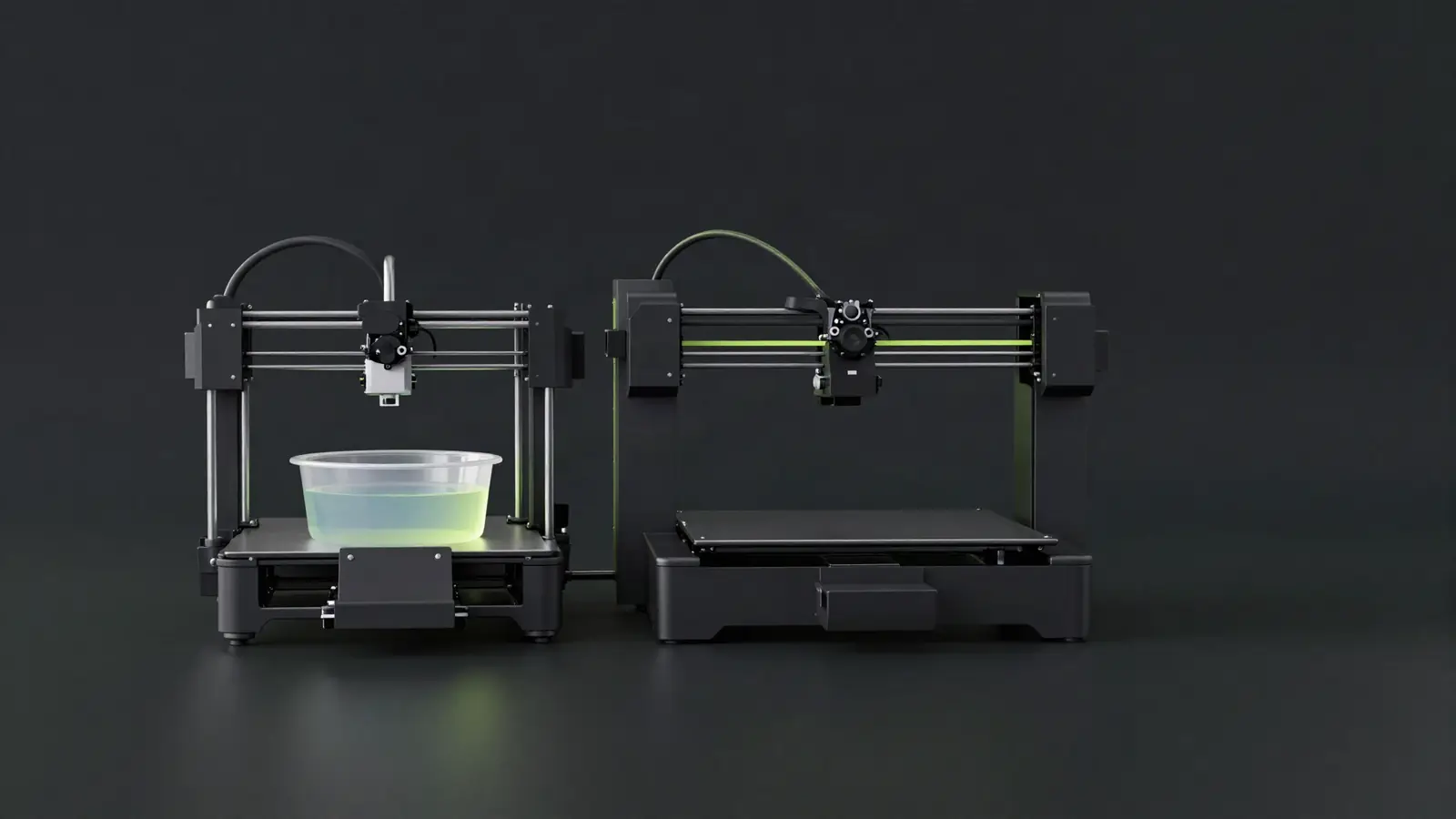
Resin and filament printers make very different parts, and they also cost differently to run. Comparing price per kilogram against price per liter doesn't tell you much on its own, because the biggest difference between the two methods is often what happens after the print finishes. This guide compares the full cost of a resin print and a filament print side by side, using the same pricing method for both.
Is resin or filament printing more expensive?
Per print, resin is usually more expensive than filament once you count everything. The resin itself often costs somewhat more per part, but the bigger difference is post-processing — washing, curing and handling consumables like isopropyl alcohol and gloves — which adds hands-on time and supplies that filament prints don't need.
Which one is right for a job depends on the detail and finish the customer needs, not just cost. But when you quote, the difference needs to be in your price.
How do you calculate the cost of each?
The method is the same for both; only the inputs change:
| Cost | Filament (FDM) | Resin (SLA/MSLA) |
|---|---|---|
| Material | Grams ÷ 1,000 × price per kg | Milliliters ÷ 1,000 × price per liter |
| Electricity | Printer watts × hours × rate | Printer (plus wash and cure station) watts × hours × rate |
| Printer wear | Printer cost ÷ lifetime hours | Also consider replacement FEP film and screens |
| Consumables | Rarely significant | Isopropyl alcohol, gloves, paper towels, filters |
| Hands-on time | Support removal, cleanup | Draining, washing, curing, support removal, sanding |
What does a side-by-side example look like?
Two comparable small prints, each taking 5 hours, on $400 printers with a 5,000-hour lifetime, a 10% failure buffer, a $20/hour labor rate and a 40% profit margin. The printer wattages are example figures — check your own machine's specifications.
| Cost | Filament print | Resin print |
|---|---|---|
| Material | 85 g at $20/kg = $1.70 | 60 ml at $35/L = $2.10 |
| Electricity | 150 W at $0.17/kWh = $0.13 | 60 W at $0.17/kWh = $0.05 |
| Printer wear | $0.40 | $0.40 |
| Failure buffer (10%) | $0.22 | $0.26 |
| Hands-on time | 15 min = $5.00 | 25 min = $8.33 |
| Extras and consumables | $0.50 | $0.75 |
| Total cost | $7.95 | $11.89 |
| Price at 40% margin | $13.25 | $19.82 |
The resin material is only 40 cents more. The bigger gap comes from the extra 10 minutes of hands-on post-processing and the consumables — together they account for most of the difference in cost.
Where do resin's hidden costs come from?
- Washing and curing time. Even with a wash-and-cure station, parts need to be moved, checked and handled.
- Isopropyl alcohol and gloves. Small per print, but constant.
- FEP film and screen replacement. These wear out and should be part of your printer-wear figure or your extras.
- Failed prints. A failed resin print can also mean a messy vat to clean, which costs time as well as material.
None of these make resin a bad choice — its detail and surface finish are worth paying for. They just belong in the price.
Which should you choose for a job?
Choose based on what the part needs, then price accordingly:
- Filament suits larger parts, functional parts and jobs where layer lines are acceptable or will be painted.
- Resin suits small, highly detailed parts like miniatures and jewelry masters, where surface finish matters most.
If you offer both, quote each job with the right method's real costs. How much to charge for 3D prints explains the full cost breakdown, and what a 3D printer costs per hour covers the electricity and wear side.
A related guide covers selling 3D prints on Etsy.